Story, Louvier Kindo Tombe
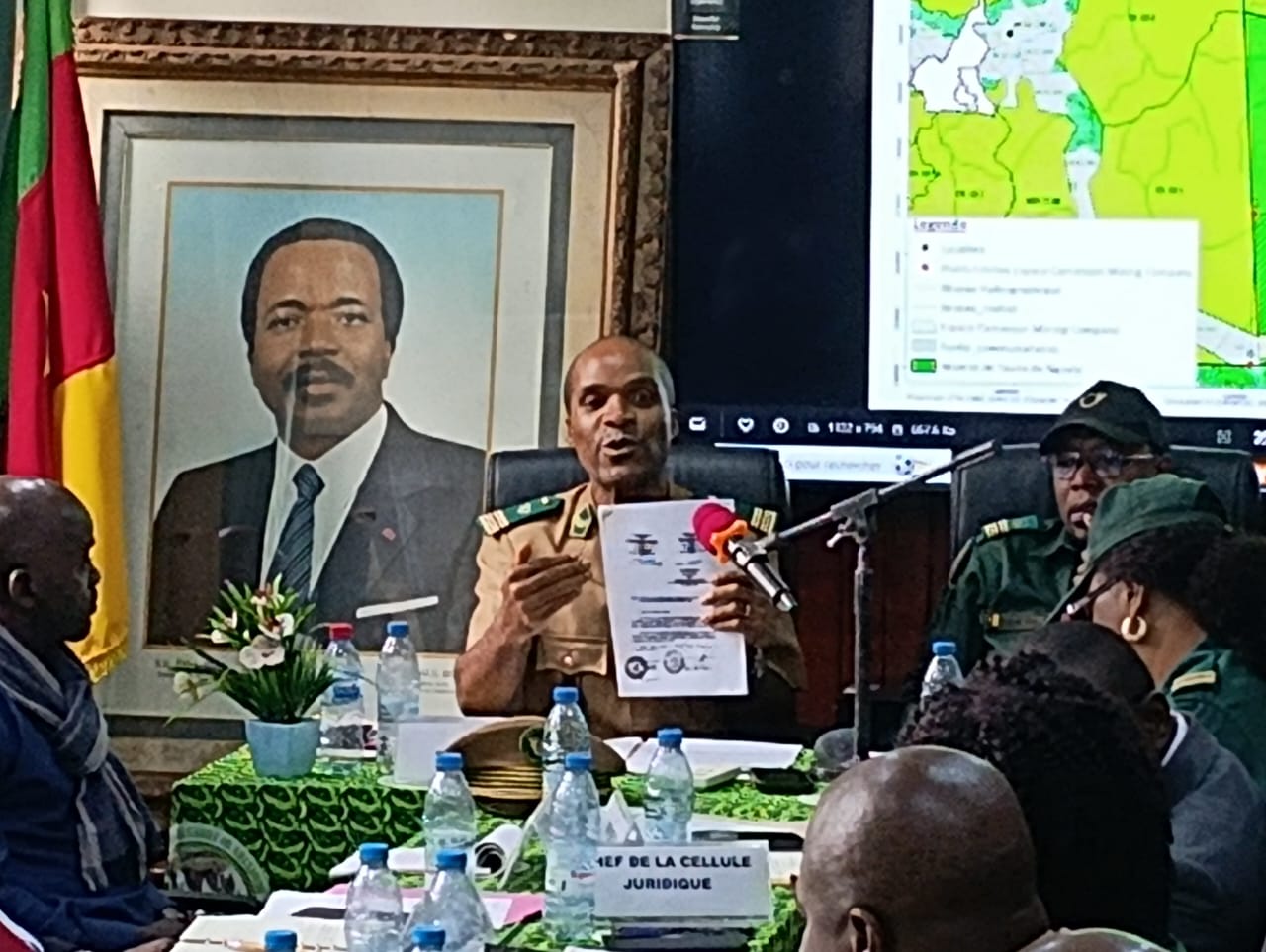
The meeting followed a damning whistleblowing campaign led by Green Development Advocates (GDA) and a coalition of over 20 civil society organizations (CSOs). The coalition recently presented cartographic data and field evidence showing that timber exploitation, under the guise of clearing infrastructure for the Mbalam Iron Ore Project, is actively destroying the Djoko Community Forest and encroaching on the protected Ngoyla Wildlife Reserve.
The paradox: ownership without access
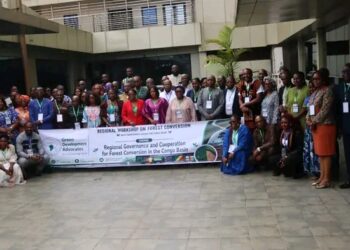
During the Bertoua meeting, the Director of Forestry at the Ministry of Forestry and Wildlife (MINFOF), Biang Mendomo Jean Daniel, delivered a statement to the Djoko community during the meeting that captured the government’s contradictory position: “You retain your community forest, no one is taking that from you, but when the time comes, when the mining project will go operational, you will understatnd you don’t have access to it anymore.”
While ministry representatives including MINFOF East Regional Delegate, Engels Ombollo Tassi, tried to reassure the indigenous Baka people that their land had not been officially expropriated, they acknowledged that operational perimeters for the mining project mean community access will be suspended and restricted.
In practice, while the Baka, who rely on the canopy for food, medicine, and cultural survival, are barred from entering, heavy machinery continues to operate inside. Satellite data presented by CSOs shows active deforestation alerts across the territory, proving that while indigenous owners are locked out, commercial timber exploitation moves forward unhindered.
Government defense: cover-ups, exactions, and attacks on CSOs
Rather than halting operations to investigate, state representatives in Bertoua, including the Regional Delegate for Mines and the Regional Delegate for Forestry, attempted to downplay the crisis while admitting key administrative and operational lapses.
The Regional Delegate for Mines on his part acknowledged that environmental impact assessments dating back to 2010 were outdated (caduc). However, he presented facts to argue that there exist a 31 March 2022 convention and subsequent development programs which legally cover current operations. Alain Fabrice Mfolou, Political and Legal Analyst at Green development Advocate, questioned whether the convention cancels the provision of the illegality of the environmental impact assessment study.
Furthermore, officials acknowledged that field exactions had occurred, while the Regional Delegate for the Littoral claimed authorities had moved to “reduce the quantity of wood exploited”, an implicit admission that timber is actively being felled and moved out of the zone under the pretext of infrastructure preparation.
To counter the fallout, ministry officials accused CSOs of “crying wolf” and manufacturing reports to “stain the image of the nation” or make money, claiming CSOs relied on “wrong contacts” and lacked a “holistic approach.”
Government representatives claimed local leaders were satisfied, given that one of them present at the meeting spoke in their language saying all is fine. Meanwhile civil society organizations, led by GDA, countered that Baka community representatives present at the meeting were under immense pressure to toe the official line, maintaining that recordings exist of local leaders voicing distress over the loss of their forest.
Civil society demands: FPIC, transparency, and reparations
The Bertoua meeting failed to concretely address the core governance failures highlighted in GDA’s report. Mining permit Decree No. 2022/355 (issued to Cameroon Mining Company Sarl) swallows 40,038 hectares of the Ngoyla Reserve and the entire Djoko Community Forest, with commercial logging titles—such as SSV n°10 02 475 and SSV n°10 02 509, active deep inside protected zones.
Under Article 17 of Cameroonian Law No. 2024/008, declassifying a wildlife reserve strictly requires a public decree, yet no such decree exists for Ngoyla, according to the CSOs leaving ongoing logging without clear legal backing. Crucially, the indigenous Baka people were never consulted, nor did they grant Free, Prior, and Informed Consent (FPIC) before heavy machinery entered their community forest. A representative of the Baka community at the meeting and who the CSOs admit meeting just for the first time stepped in and declared that the community was actually consulted.
The bottom line
The government’s response reveals a strategy of administrative deflection: denying accusations of illegality while allowing timber clearing to proceed unabated. By telling the Baka community that they “own” a forest they cannot enter, even as commercial loggers continue felling trees, the state creates a double standard where indigenous conservationists are locked out, but exploitation is granted a green light.
In response, civil society coalitions continue to demand an independent administrative inquiry, public disclosure of all project conventions, an immediate halt to unpermitted logging, and comprehensive reparations for the Baka community.