By Louvier Kindo Tombe
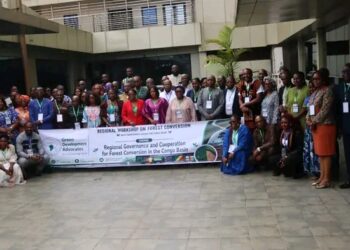
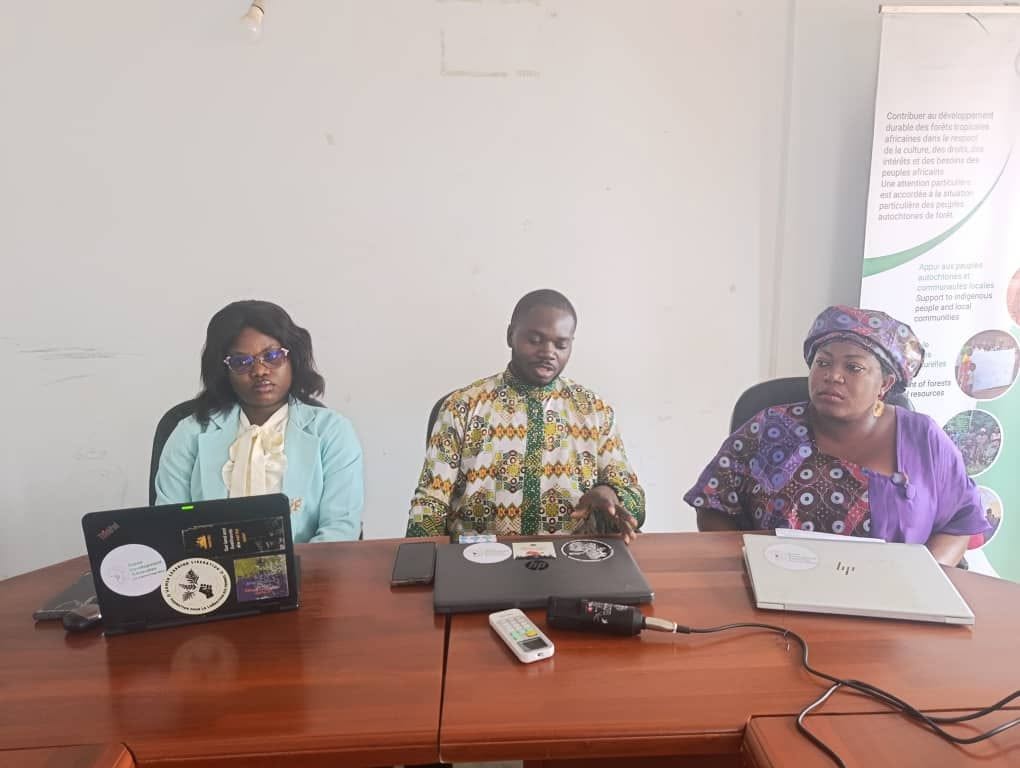
A coalition of over twenty prominent Cameroonian civil society organizations has presented damning evidence of what they term an organized campaign of “timber looting” operating under the convenient cover of an industrial mining project in the country’s East region. The shocking data and field photographs were laid out across the presentation tables in Yaoundé during a press conference organized by Green Development Advocates (GDA). The mapping analysis unveiled by the civil society organizations in Yaoundé exposes a profound territorial conflict, one that reveals a massive, systemic corporate invasion sweeping across Cameroon’s East region.
“Authorities are playing with the intelligence of the indigenous Baka community and technically and illegally exploiting their community forest and exposing their livelihoods,” warns Christian Mbani, a jurist at GDA.
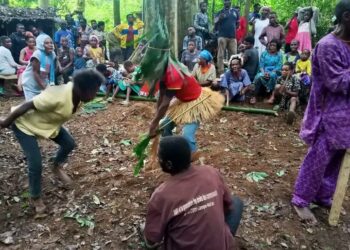
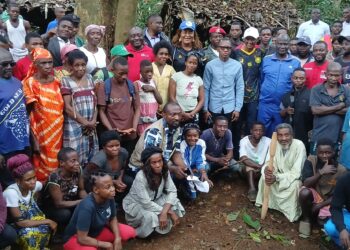
Central to the press conference was a tragic warning relayed directly from the ground by the indigenous Baka community: “If this forest is destroyed, the cultural identity of our people will be lost, along with our basic means of subsistence.”
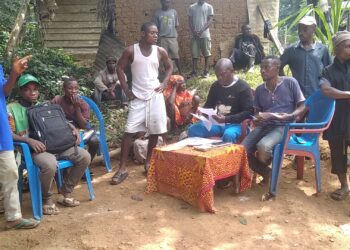
Feedback from the East region indicates that standing in the shifting shadows of the Djoko forest, this crisis is not measured in map coordinates or legal decrees; it is heard in the unfamiliar, terrifying crash of centuries-old trees hitting the forest floor. For generations, this canopy has been their pharmacy, their supermarket, and their temple. Today, that entire life support system is being severed by the relentless advance of heavy machinery.
The roots of the crisis lie in a profound mapping conflict. On August 17, 2022, a state mining permit (Decree No. 2022/355) granted Cameroon Mining Company Sarl rights over a 768.5-square-kilometer territory in the Upper-Nyong division. However, cartographic analysis presented at the press conference reveals a shocking reality: the permit boundaries overlap directly with 40,038 hectares of the protected Ngoyla Wildlife Reserve and completely swallow the Djoko Community Forest.
For the Baka, who were legally granted the Djoko forest as compensation when the Ngoyla Reserve was originally created, the invasion represents an existential threat. The heavy machinery arrived entirely without their Free, Prior, and Informed Consent (FPIC), threatening the traditional knowledge, health, and food security of a culture now facing erasure.
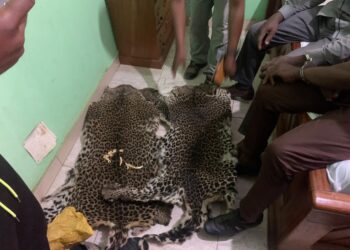
Under the pretext of clearing infrastructure for the Mbalam iron ore project, industrial logging operations have aggressively pushed into these conservation zones. On the ground, investigators documented massive timber logs, felled and stacked inside the reserve under specific commercial titles like SSV n°10 02 475 and SSV n°10 02 509, with fresh red dirt roads carved deep into the virgin ecosystem.
The scale of destruction brought to light in Yaoundé is happening at a terrifying pace. Data from Global Forest Watch (GFW) presented by the coalition highlights a staggering timeline of loss between late 2025 and mid-2026: the Ngoyla Wildlife Reserve alone triggered 42,566 deforestation alerts in a seven-month span, while the Djoko Community Forest suffered 2,347 alerts. This canopy fragmentation shatters vital wildlife corridors, driving endangered species into conflict with surrounding villages and exposing the dense forest to rampant commercial poaching.
The coalition points to a critical failure in governance and transparency, noting that under Cameroonian forestry law (Article 17 of Law No. 2024/008), any partial or total declassification of a wildlife reserve strictly requires a public decree. Because no such decree has ever been made public, a deep shadow of illegality hangs over the ongoing logging.
“We cannot allow international funding and corporate infrastructure projects to serve as a legal smoke-screen for environmental lawlessness,” states Mbia Danielle, Project Lead at GDA and Coordinator of the IFI Monitoring Group platform. “International partners and financial institutions must look at the data laid bare today. We are calling for immediate institutional transparency and independent, community-led oversight before an irreplaceable ecosystem and its people are permanently erased.”
To resolve this crisis, the signatory organizations demand that the Government of Cameroon immediately launch an independent administrative inquiry into the timber plundering, make all declassification records public, and protect the territorial borders of the Djoko Community Forest and the Ngoyla Wildlife Reserve.
They insist that the mining and forestry companies involved immediately halt operations violating indigenous territories, strictly respect the principle of FPIC, and provide comprehensive reparations to the Baka people for damages to their health, food security, and cultural identity.
Finally, the coalition calls upon international technical and financial partners to step up funding for participatory forest governance and empower independent citizen monitoring watchdogs to ensure long-term corporate and regulatory compliance.
As international eyes turn toward the Congo Basin for global climate solutions, the crisis exposed in Yaoundé serves as a stark reminder that environmental conservation cannot be separated from human rights. Without swift intervention, one of the nation’s most vital ecological assets, and the ancient culture that protects it, could be irreversibly severed.