 Story, Louvier Kindo Tombe
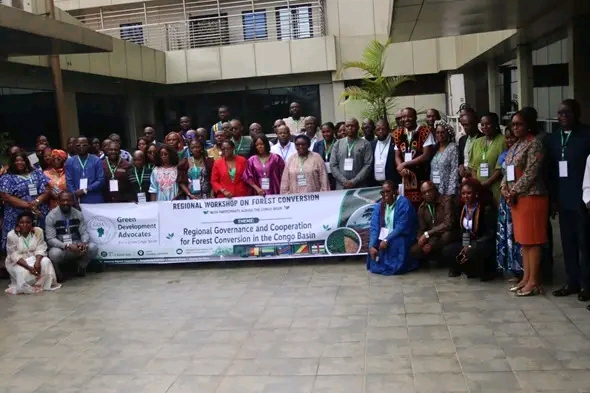
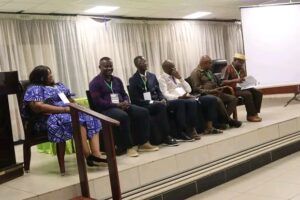
For generations, the dense tropical canopy stretching across the heart of Central Africa was considered an endless green barrier, the “second lung” of the earth. But inside the conference hall at Hotel La Falaise in Yaoundé, a sobering reality settled over the 100 delegates, environmental experts, and indigenous community leaders gathered under the banner of Green Development Advocates (GDA).
The forest is no longer just being logged; it is being permanently transformed.
Across five Central African nations, primary rainforests are being sliced open to make way for massive agro-industrial plantations, infrastructure corridors, and industrial mining projects.
Data presented by the World Resources Institute (WRI) revealed a staggering toll: between 1990 and 2020, the Congo Basin lost over 352,000 square kilometers of forest cover,roughly 8.5% of its total surface area.
Opening the sub-regional conference, GDA Coordinator Aristide Chacgom, captured the core mission of the multi-day forum: stopping a crisis before the forest reaches a point of no return.
“We brought together representatives from sub-regional countries to review what is happening on the ground and identify strategies to invert this trend… Our vision is that of a Congo Basin that is always greener,” he said.
“We promote sustainable development that takes into account the preservation of forests, but also the rights of communities,especially indigenous populations like the Baka, Bagyeli, Bedzan, and Bakola who live in the forest and whose practices do not impact it.”
Rethinking National Growth and Public Investment
Bridging the divide between economic necessity and environmental stewardship, academic governance expert Prof. William Malla argued that saving the Congo Basin does not mean halting economic development, it requires fundamentally changing how public budgets are structured and financed.
Pointing to macroeconomic benchmarks like Cameroon’s 2026 public investment budget of roughly 2,031 billion FCFA, Prof. Malla outlined the path toward an integrated regional strategy:
“The challenge is first and foremost regional land-use planning. All sectors need to exist in order to build growth, it is growth that creates added value and jobs, which is the macroeconomic indicator every country dreams of,” he told reporters.
“The advocacy to be made is to strengthen integration across sectors… What will change the perspective of our countries and construct our discussions is making public investment directly linked to greening, ecosystem restoration, and sustainable commodities.”
A Human Cost Beyond Statistics
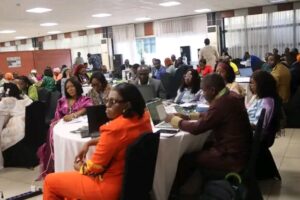 While macroeconomists view land use through the lens of national revenue, indigenous representatives reminded the plenary that forest clearance carries a devastating human price tag on the ground.
Guy Mousselé Diseke, President of the Association Bomassa in the Republic of the Congo, delivered an impassioned testimony on how large-scale land allocations destroy the fabric of forest-dependent communities:
“The forest represents everything for us: it is our pharmacy, our bakery, our store. Consequently, the clearing of forests leads to the impoverishment of populations… In the Republic of the Congo, 65% of forest land, and in fact nearly 94%, has already been allocated to logging companies, miners, and agribusiness.”
“In some places, there is even an overlap of permits. Indigenous peoples are left with nothing. They tell you that you have rights, but there are areas where you can no longer enter, even though these are extremely sacred places, ancient villages, and ancestral graves.”
Unlocking Sustainable Financing and Real-Time Action
A pivotal dimension of the conference focused on answering the financial question: how to secure long-term, direct funding for Congo Basin preservation without relying solely on traditional aid.
Dedicated sessions examined financial and economic mechanisms to mobilize capital for green growth, emphasizing that local communities and indigenous stewards must have direct access to conservation funds.
International funding platforms and rights-based organizations—including the Central African Forest Initiative (CAFI), REPALEAC, the Global Greengrants Fund (GGF), the Forest Peoples Programme (FPP), and ECJ/Fund—tabled innovative funding models designed to bypass bureaucratic bottlenecks and finance grassroots forest guardianship directly.
Simultaneously, technical experts from Global Forest Watch (GFW), FODER, FLAG, and the Environmental Investigation Agency (EIA) presented cutting-edge satellite and digital transparency tools. These systems allow field monitors to track unauthorized forest conversion in real time, exposing illegal land grabs before the chainsaws finish their work.
Honoring a Legacy
On the sidelines of the workshop, the gathering took on a deeply emotional note as Green Development Advocates (GDA) celebrated the 15th anniversary of its founding on June 30, 2011. The milestone provided a backdrop to pause and honor the memory of the organization’s founder, the late Dr. Robinson Djeukam, marking roughly a decade since his passing in 2015.
Delegates paid tribute to the pioneering jurist whose legal brilliance laid the groundwork for community land rights, biodiversity protection, and forest governance legal frameworks across Central Africa.
Guy Mousselé Diseke offered a moving personal testimony remembering Dr. Djeukam’s monumental impact on forest rights advocates across the sub-region:
“Dr. Robinson Djeukam was a great master who guided us toward the recognition of community rights and the protection of biodiversity.”
“He was an eminent jurist who enabled us to be effective in the work we are trying to do. In his memory, it was very important that we be present.”
As the Yaoundé summit drew to a close, the consensus across Central Africa was unequivocal: preserving the Congo Basin demands harmonized laws, sustainable financing mechanisms, transparent supply chains under frameworks like the EU Deforestation Regulation (EUDR), and above all, honoring Dr. Djeukam’s legacy by securing the land rights of those who have guarded these forests for generations.