Story, Louvier Kindo Tombe
Farming today is changing. People are now using computers, soil sensors, and modern tools to grow food. But a new farming method needs strong theory and practical training to succeed.
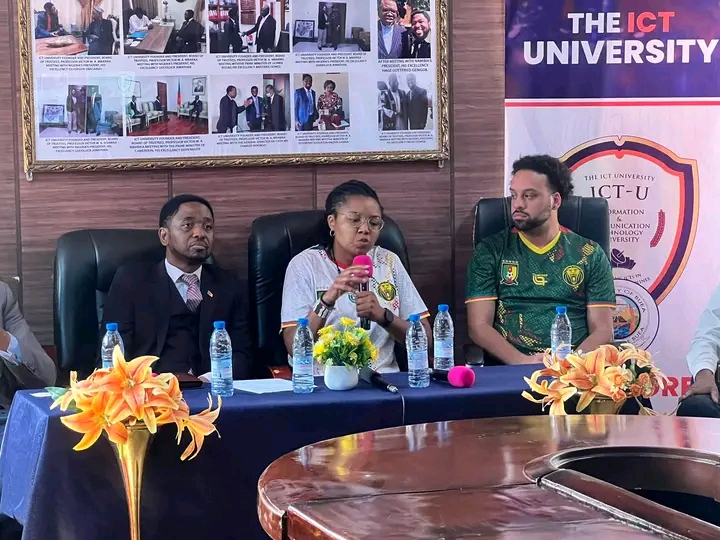
This was the main message at a press conference at The ICT University in Yaoundé. The founder of the university and visiting guests from the University of Cincinnati in Ohio, USA, discussed a possible partnership that will boost the university’s own Smart Agriculture Engineering program.
”The work being done here connects classroom training with real solutions for the community,” said Dr. Lauren Forbes, Assistant Professor of Public Administration and Director of the Center for Truth, Community Healing and Transformation.
The U.S. delegation that arrived in the country for a working visit with staff of The ICT University also featured Dr. Kelly Merrill Jr., Assistant Professor of Health Communication and Technology at the university.
During the press conference, the Founder of The ICT University, Prof. Victor Mbarika, talking about the smart agriculture engineering program, revealed that the university has obtained government approval.
”We have got approval from the Ministry of Higher Education, and we have bought the land and materials needed for practical training. Everything is ready,” he said.
To him, getting land and government approval is only part of the work. The real goal is to make sure a brilliant child from a village can join without worrying about money.
Running a high-tech engineering course, which is supervised by FASA at the University of Dschang, comes with a big challenge: school fees and training costs can be too high for ordinary families. A plan for grants and support is being envisaged to help regular students join the course.
Prof. Victor Mbarika shared a major update on how the university plans to help students:
“We know that many students face money challenges. Because of this, we are working with leaders at the Ministry of External Relations to secure joint grants and financial assistance so that students who cannot easily afford the fees can still get trained.”
Building on its existing international networks, such as its ongoing collaboration with the Federal University of Lavras in Brazil, The ICT University continues to team up with global institutions to give its students the best practical training.
The long-term dream is to help create over 10,000 jobs and business opportunities across Cameroon.
A Shared Vision Across the Sea
The talks followed a busy field trip by the visiting delegation to some sites acquired by The ICT University for the smart agriculture engineering program, including the PIGA Group Agricultural Farm in Ndikiniméki. There, future students of The ICT University will learn how to use modern farming technology hands-on, instead of just reading books.
The visitors from America saw how local work is joining hands with international experience.
Reflecting on what is being discussed, Dr. Lauren Forbes added:
“We are very happy to explore how schools from different parts of the world can share knowledge, help students, and support long-term progress.”
As The ICT University continues to forge strategic international alliances and break down financial barriers for aspiring engineers, its smart agriculture initiative is rapidly evolving from a visionary concept into a tangible engine for Cameroon’s agricultural future.