Story, Louvier Kindo Tombe
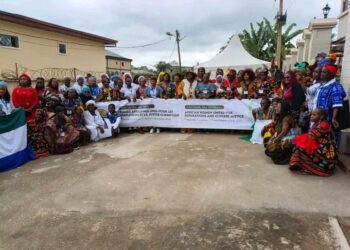
 Inside the Apostolic Church hall, what begins as a technical training quickly evolves into a deeper conversation about survival, independence, and safety.
The initiative, led by the Cameroon Economic Policy Institute under the Henri Kouam Foundation, is anchored on the opportunities of the African Continental Free Trade Area—but with a clear social mission: linking trade to the fight against violence against women.
For Henri Kouam, the message is direct. In his words, he stresses that:
“When women are economically empowered and integrated into formal trade systems, they gain independence, they gain voice, and they are less vulnerable to cycles of violence and exclusion.”
The urgency of that message is underscored by stark figures shared during the training. According to UNFPA estimates, more than 50% of married women in Cameroon experience intimate partner violence, while about 21.5% of women have suffered physical or sexual violence from a partner. Reports also indicate dozens of femicide cases annually, many linked to domestic settings.
In addition, women represent nearly 80% of agricultural production, but a large majority remain confined to informal markets, limiting both income stability and protection under the law.
Egbe Fride, who led part of the session, explains that gender-based violence is not only physical but also economic and structural—factors that often trap women in dependency and silence.
The training also highlights that around 70% of women in Cameroon operate in the informal sector, making them particularly vulnerable to exploitation while limiting their access to formal trade protections.
Against this backdrop, CEPI positions AfCFTA as a turning point. By helping women transition into structured value chains, access export systems, and understand trade procedures, the goal is not only economic growth—but reduced vulnerability.
Policy discussions also point to Cameroon’s 2026 special fund of 50 billion FCFA for women and youth entrepreneurship, a national effort aimed at boosting financial inclusion and business development.
As the session winds down, the tone shifts from statistics to solutions—from vulnerability to opportunity.
And at the center of CEPI’s message is a simple but powerful idea: economic empowerment is not separate from protection—it is one of its strongest foundations.
 A key recommendation was the stronger integration of women into formal trade systems under the AfCFTA, enabling them to move beyond informal markets and access structured regional and international trade opportunities.
Participants were also trained on export procedures, documentation requirements, and cross-border trade processes to help them scale their businesses beyond local markets. CEPI emphasized that understanding these systems is essential for women seeking to compete effectively within formal value chains.
In addition, the workshop introduced participants to practical digital tools such as the African Trade Observatory and non-tariff barrier reporting platforms. These tools are intended to help women identify market opportunities, track trade conditions, and overcome administrative barriers in cross-border commerce.
The training further highlighted the importance of financial inclusion, encouraging access to credit, start-up support, and entrepreneurship funding schemes targeted at women-led businesses. CEPI also stressed the value of forming cooperatives to strengthen collective bargaining power, improve market access, and reduce economic vulnerability.
Finally, participants were encouraged to build skills in digital trade and compliance with regional standards, seen as essential for competitiveness in formal markets and for sustaining long-term economic independence.