Story, Louvier Kindo Tombe
 In a packed hall in Yaoundé, the discussion did not feel like distant policy talk. It felt grounded—closer to the farms, markets, and small workshops that keep Africa’s economy moving.
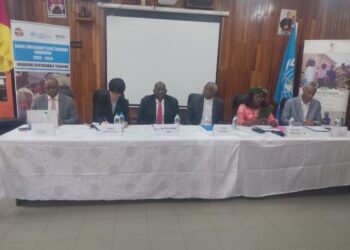
At the Trade + Sustainability Hub 2026, held alongside WTO Ministerial Conference MC14, attention turned to whether the African Continental Free Trade Area is truly reaching the small and medium-sized enterprises it was designed to empower.
The session, convened by the Cameroon Economic Policy Institute in partnership with the International Institute for Sustainable Development, placed SMEs at the center of the debate.
Across Africa, SMEs account for nearly 70% of economic activity. Yet most still operate informally, far from the formal trade systems AfCFTA is meant to unlock.
For Henri Kouam, the gap is not about vision, but execution.
“AfCFTA is a powerful framework, but its real success will be measured by whether small businesses on the ground can actually access the opportunities it creates. Without that, integration remains incomplete.”
That challenge was echoed throughout the room.
Bama Cham, participant explained how value chains often function like a pyramid—where small producers feed into larger exporters who access international markets. While efficient in structure, it leaves many at the base dependent and poorly informed.
In sectors like cocoa, thousands of farmers supply production, but only a few exporters control market access. Between them lies a persistent gap in information and pricing power.
Jacqueline Tiencheu, one of the early women exporters under AfCFTA frameworks, shared her experience navigating both opportunity and structural barriers, highlighting the difficulty of scaling without strong systems of support.
Participants also pointed to persistent bottlenecks—informal charges along trade routes, limited market data, and weak access to finance—all of which continue to slow SME participation.
Despite these challenges, new tools such as AfCFTA certification systems were presented as steps toward simplifying trade and improving transparency.
But as discussions closed, one message stood out clearly: AfCFTA is no longer just about policy design. Its success will depend on whether it can move from paper to practice—into the daily reality of the SMEs who form the backbone of Africa’s economy.
Because, as Kouam’s message suggested, integration is not complete until it is felt where it matters most: on the ground.
 Key recommendations from the session included strengthening access to reliable market information, reducing informal charges along trade corridors, and improving financing mechanisms tailored to small and medium-sized enterprises. There was also a strong call for expanding digital trade tools and certification systems to make cross-border transactions simpler, faster, and more transparent for grassroots actors.
They further emphasized the need for continuous capacity building, especially for rural producers and informal traders, to ensure they understand export procedures and regional trade opportunities. Stakeholders stressed that effective implementation of AfCFTA will depend on inclusive outreach, stronger institutional coordination, and policies that directly address the constraints faced by SMEs on the ground—transforming trade integration from a policy ambition into a lived economic reality.