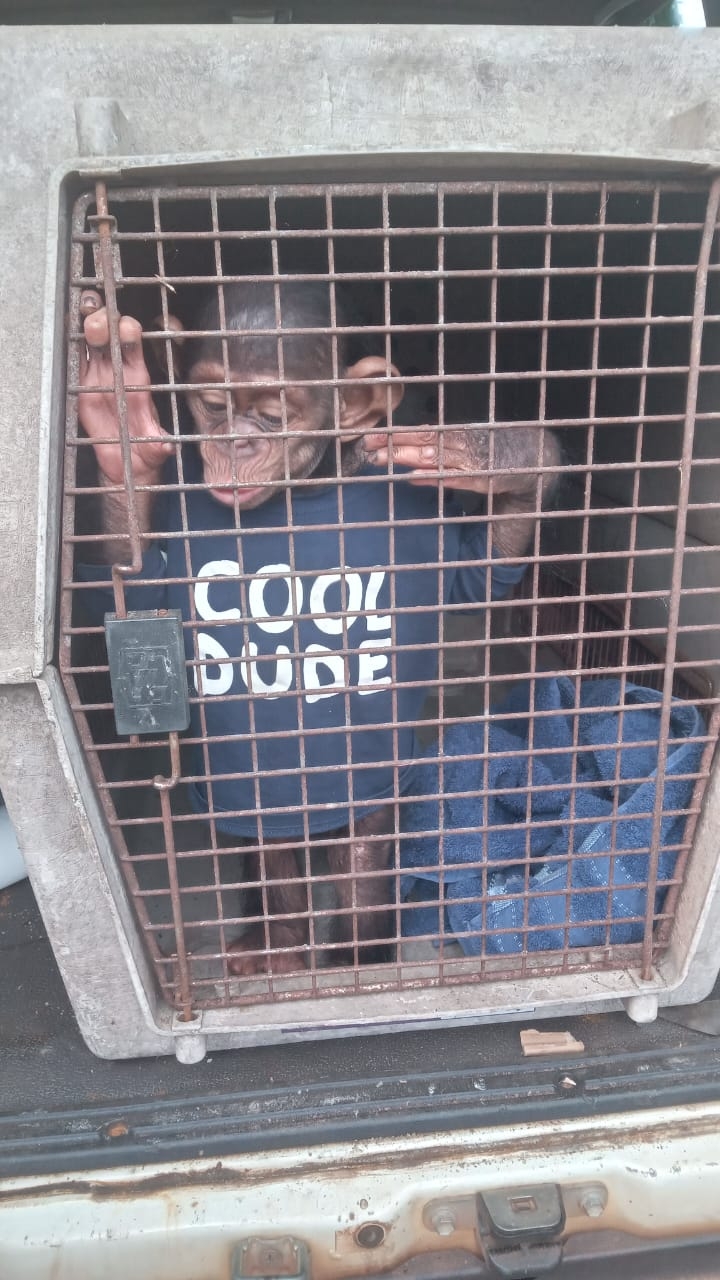
The Department of Water and Forests and the Judicial Police (PJ), supported by the NGO Conservation Justice (CJ), arrested four individuals in Libreville on August 12, 2026, who were found in possession of a baby chimpanzee they were allegedly attempting to sell illegally.
The arrest took place in a neighborhood in Libreville. Among the four suspects were two women aged 31 and 51. The four individuals were caught in the act of illegally possessing and attempting to sell a nine-month-old chimpanzee, a species that is fully protected under Gabonese law.
This attempted sale was reportedly not the first for one of the suspects. The baby chimpanzee had allegedly already been sold for 350,000 CFA francs in the recent past.
Under Article 92 of the Forestry Code, the possession of fully protected animal species is prohibited. Following this violation of the law, the suspects were questioned on August 12, while the main suspect remained in police custody.
Under Articles 92 and 199 of the Forestry Code, as well as the provisions of Decree No. 163, the four alleged wildlife traffickers face legal sanctions. Under Article 275 of the Forestry Code, they may be sentenced to three to six months’ imprisonment and a fine ranging from 10,000 to 10 million CFA francs, or to either of these penalties alone.
In Gabon, this is not the first time that a chimpanzee or another fully protected wild animal has been rescued from wildlife traffickers. However, handling such animals also carries significant health risks, including zoonotic diseases, meaning diseases that can be transmitted from animals to humans, such as Ebola. The current situation in the Democratic Republic of Congo (DRC) should serve as a warning.
With the support of Gabon Untouched, the chimpanzee was transferred to the Lékédi Park, managed by the Lékédi Biodiversity Foundation, a member of the Pan African Sanctuary Alliance (PASA).
Wildlife sanctuaries play a crucial role in providing shelter and care for wild animals rescued from trafficking in Gabon. Eric Willaume, Director of the sanctuary, said:
“Chimpanzees are fully protected species and can transmit contagious and dangerous diseases to humans, including hepatitis, tuberculosis, Ebola, monkeypox (Mpox), and many others. Keeping primates in captivity always ends badly for private individuals, due to the risks of injuries, infections, aggression, and the physical strength of primates.”
Anyone in possession of a fully protected wild animal is therefore encouraged to voluntarily surrender it to the Department of Water and Forests, thereby avoiding legal proceedings.
Fanta Mabo