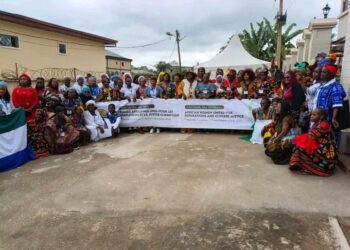
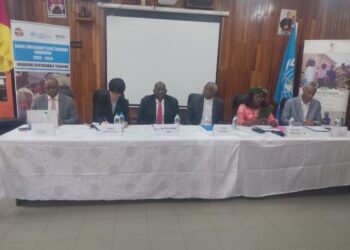
Story, Louvier Kindo Tombe
At first glance, the atmosphere at Noah’s Club was purely celebratory. Music, laughter, and the spirit of civic engagement filled the air as crowds gathered for the annual French Volunteering Week. However, amidst the festivities, one organization was busy ensuring that the “green” in climate action remains accountable to the people it serves.
Jeunes Volontaires pour l’Environnement (JVE) Cameroun successfully transformed this festive backdrop into a powerful classroom for community rights, focusing on a critical but often overlooked tool: the Independent Redress Mechanism (IRM) of the Green Climate Fund (GCF).
Led by Project Assistant Mamouth Oumarou and Communications Officer Venetia Mengue, the JVE delegation brought a burst of creative energy to the event.
Their mission was to prove that climate governance does not have to be dry or elitist. While many attendees arrived expecting standard exhibitions, they were met with educational comic books that break down complex legal rights into relatable narratives and the “Road to Redress” game.
”We wanted to break the ice and show that talking about rights doesn’t have to be intimidating,” explained Mamouth Oumarou.
“By simulating the journey of a community seeking justice, we made the IRM tangible. It’s about moving from theory to action.”
This simulation allowed participants to experience the journey of a community facing a problematic climate project, forcing them to navigate the hurdles of asserting their rights in real-time.
“The game served as a catalyst,” the team noted. “It sparked conversations about asserting rights that traditional institutional tools simply couldn’t generate.”
Why the IRM Matters for Every Cameroonian
The core message from JVE Cameroun was unapologetically direct: the IRM is not just for specialists; it is a fundamental right. As the Green Climate Fund pours resources into local projects, those living near project sites must have a voice if things go wrong.
Whether dealing with land disputes, environmental damage, or a lack of inclusion, the IRM provides a bridge for grievances to be heard at the highest levels of international finance.
”For too long, these mechanisms have been seen as the exclusive preserve of climate finance experts,” said Venetia Mengue.
“Our goal here was to flip that script. We are telling local communities that if a project affects your land or your livelihood, you have a direct line to be heard.”
For many at Noah’s Club, this was an eye-opening discovery, revealing that international climate funds come with built-in requirements for accountability and transparency.
A Strategic Window for Outreach
This initiative is a cornerstone of the CSO Advocacy Grants project, supported by the GCF’s Independent Redress Mechanism.
Running from September to December 2025, the project focuses on empowering communities affected by climate projects, training civil society actors to navigate grievance systems, and ensuring climate justice becomes a lived reality rather than a theoretical concept.
By choosing a public volunteering forum rather than a private boardroom, JVE Cameroun sent a clear signal that climate governance is built on the ground.
“Climate governance is not built behind closed doors alone,” the delegation emphasized during their sessions. “It is also shaped in the spaces of volunteering, civil society, and everyday civic engagement.”
By informing and equipping grassroots actors, the organization is ensuring that the legal protections promised by global institutions actually reach the villages and towns of Cameroon.
At Noah’s Club, the message was clear: rights are only useful if the people they protect actually know they exist.