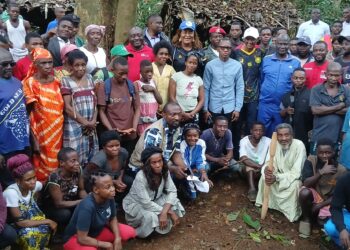
Story, Louvier Kindo Tombe
“I grew up in the forest. It fed us, healed us, and sent our children to school.”
Jeanette pauses, reflecting on what has changed. “Today, we are losing forests near the rivers in Ntui… but we are trying to adapt.”
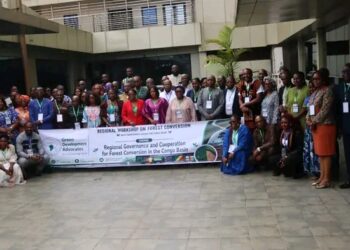
Her story echoes across communities in Cameroon, and it set the tone for a powerful conversation held in Yaoundé ahead of the International Day of Forests.
Organised by Green Development Advocate in partnership with WoMin, the webinar did more than present statistics, it gave a human face to the forest economy, while launching a compelling photobook titled In the Embrace of the Earth | Dans l’étreinte de la Terre.
A global economy, a local reality
Globally, forests generate an estimated 1,500 billion dollars annually, about 1% of the world’s GDP. In the Congo Basin, they contribute roughly 2.5% to the combined GDP of six countries.
In Cameroon, forests rank as the third-largest export after oil and cocoa. But beyond national revenue, they are something far more personal.
“For us, the forest is everything,” said Papa Luc, a Baka community member. “It is our supermarket, our pharmacy, our culture.”
This dual reality, forests as both economic engines and lifeline, was at the heart of discussions marking this year’s international forest day theme: “Forests and Economies.”
From numbers to names
Facilitating the session, Alain Mfolou, Jurist at GDA stressed the need to look beyond figures.
“Forests are not just resources. They are systems of life. If communities are excluded, the economy we talk about becomes incomplete.”
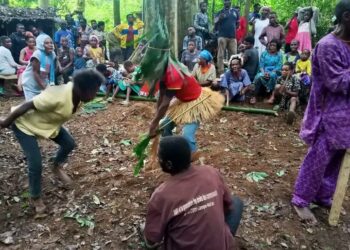
The webinar transitioned from policy to people with the launch of the photobook, a visual and narrative journey into communities living around the Campo Ma’an National Park.
Through images and testimonies, the book captures what many outsiders rarely see.
“They tell what people might see but not understand about forest communities,” one contributor noted.
“It’s something we all need to master.”
“We are not destroying the forest”
One striking message emerging from the photobook is the ecological harmony of Baka communities. Images show men and women entering the forest with little more than small tools, leaving minimal impact. A community voice featured in the project, puts it simply:
“We live with the forest, not against it.”
Yet, climate change and development pressures are reshaping that relationship.
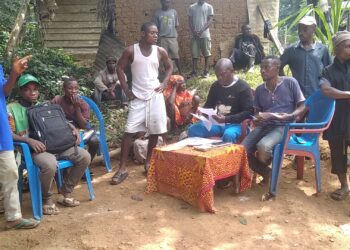
In Campo, one participant lamented: “The seasons are no longer the same. Climate change has confused everything, and we have nowhere to complain.”
Law, policy and exclusion
While the forest economy grows, concerns are mounting over Cameroon’s evolving forest law.
Stakeholders say the ongoing reforms—though promising—still leave gaps:
Community voices remain limited in forest conversion decisions
Memorandums of understanding (MoUs) enabling local autonomy are missing
Forest royalties once directly benefiting communities are now redirected to councils
Marius Mongo, Jurist at GDA, who presented on the forest law, reacting during the discussions, warned:
“If communities are not fully included, then they risk becoming victims of the very economy built on their land.”
A call beyond conservation
 More than a celebration, the International Day of Forests became a moment of reflection, and a call to rethink development.
The photobook, rooted in years of research and inspired by African ecofeminist thought, particularly the legacy of Wangari Maathai, positions communities, especially women, at the center of solutions.
Daniella, another scribe of GDA who Co organised the event, emphasized gratitude and urgency:
“We must thank these communities, but more importantly, we must listen to them.”
Between survival and opportunity
As conversations ended, one question lingered: How can communities better benefit from forests without losing them?
For Jeanette, the answer lies in balance: “We are learning new ways, agriculture, small transformation activities, but we still need the forest. Without it, we lose everything.”
Her voice, like many others, reminds us that forests are not just about carbon or commerce. They are about people.
And as the world marks the International Day of Forests, their message is clear:
The future of the forest economy must include those who have always called it home.