Story, Louvier Kindo Tombe
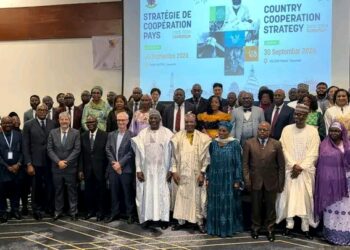
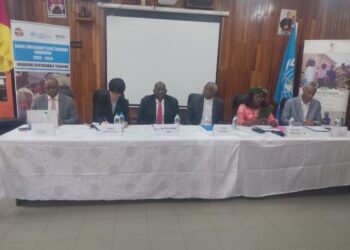
Hosted at the United Nations Centre for Human Rights and Democracy in Central Africa, the symposium, organized together with the Cameroon Association of English-speaking Journalists (CAMASEJ) Yaounde Chapter, brought together media professionals, rights advocates and institutions for frank discussions on press freedom, safety and the future of journalism in Cameroon.
From the outset, the tone was one of openness and collaboration. Welcoming participants, Kiven Fonyuy, Programmes Officer of the UNCHRD-CA, described the venue as a shared space for dialogue:

“The Human Rights House is everybody’s house. We are welcome to discuss anything that can improve the life of the profession. I hope this symposium will be a successful one.”
That sense of collective purpose was echoed by Viban Jude, President of CAMASEJ, who reflected on how far the initiative had come:

“This started like a small discussion, but today we are here at this symposium. We are ready to work with you at any time. We are grateful for this event and hope it will go a long way in strengthening our profession.”
A Profession Under Strain
 As conversations deepened, the challenges facing journalists in Cameroon came into sharp focus.
Presenting on behalf of CAMASEJ,
Amindeh Blaise Atabong, Secretary General of CAMASEJ, delivered a candid assessment of the media landscape, highlighting legal, economic and operational constraints.
“There is no political will to give newspapers free license to operate. When you don’t toe the line, you can be called to order,” he said.

He further pointed to the use of financial pressure as a control mechanism:
“When you try to criticise the government, they take out the fiscal card to stifle you.”
Beyond policy constraints, he described a working environment marked by intimidation:
“Some uniform officers feel that when they arrest and detain a journalist, they will earn a promotion… intimidation during news gathering affects our work.”
He also warned about the growing trend of self-censorship within newsrooms:
“At times we shelve stories that might affect our advertisers or stakeholders.”
The absence of a Freedom of Information law, he added, continues to limit access to vital public data:
“This act is very important because it is going to enable us do our job perfectly.”
From fragile business models where most newspaper publishers die with their papers, to digital surveillance, lack of training, conflict-related risks and gender-specific challenges, the diagnosis was clear: journalism in Cameroon is under pressure on multiple fronts.
Safety First, Always
If the challenges were stark, the message on safety was even more urgent.
Speaking on the protection of media professionals, Kiven Franklin stressed that risks are not only external but also internal—linked to decisions journalists make in the field.
“Safety and protection is not only about dealing with external threats but also internal threats.”
Drawing from the realities of reporting in conflict zones such as the North West and South West regions, he delivered a message that resonated across the room:
“There is no renowned or good journalist in the grave. You must be alive to defend press freedom.”
He urged journalists to rethink the idea of “information at all cost”:
“It’s not every information that is true and factual that is fit for public consumption… some information can lead to turmoil.”
He also cautioned against dangerous reporting practices:
“Don’t go undercover. You can be disappeared without anyone knowing.”
His advice was practical and direct, always inform your newsroom, assess risks carefully, and understand that safety protocols depend on the situation.
That call was reinforced by Dr. Evelyne Mengue A Koung, President of the Union de la Presse Francophone, who placed responsibility squarely on journalists themselves:

“A good journalist is one who is alive.”
She emphasized preparedness and awareness:
“We are the first safety keepers of ourselves. We should prepare ourselves and understand our environment.”
And on professional conduct, she was clear:
“Journalists are not spies; you have to identify yourself… a journalist has to stay by the law even in a conflict zone.”
Journalism and Peacebuilding
 Beyond the risks and restrictions, the symposium also explored the broader role of journalism in society.
Discussions highlighted the importance of a free and responsible press in fostering dialogue and contributing to peacebuilding, particularly in fragile contexts.
In conflict situations, participants noted, responsible reporting can either inflame tensions or help build understanding—making ethical journalism more critical than ever.
More Than a Symposium
Participants left with more than just talking points. There was a shared recognition that while the challenges are significant, the path forward lies in collaboration, stronger protections and a renewed commitment to ethical journalism.
From what began as a “small idea,” the conversations it sparked were anything but small.
And in those conversations lies a quiet but powerful resolve, to protect the profession, uphold the truth, and above all, ensure that those who tell the story live to tell it.