 Story, Louvier Kindo Tombe
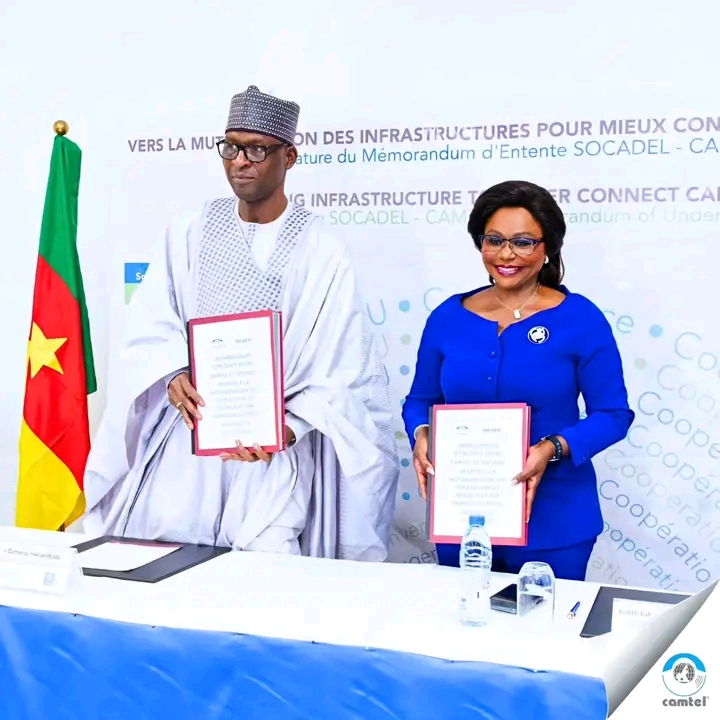
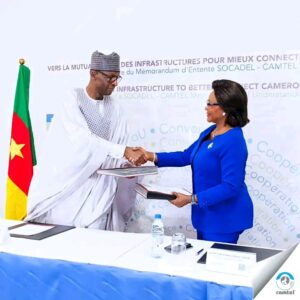
At the Star Land Hotel in Yaoundé, pens clicked and hands shook as leaders from two major state companies signed a historic agreement.
For years, electricity and internet companies in Cameroon have worked separately. They built separate poles, ran separate cables, and often cluttered city streets while spending extra money.
But on October 16, 2026, SOCADEL and CAMTEL decided to change how things are done by officially signing a partnership to share their networks and infrastructure, turning regular electricity poles into digital pathways for high-speed internet and power lines alike.
Both companies bring their own strengths to the table, with CAMTEL providing a large network of optical fibre cables and international connections, while SOCADEL provides electrical poles, pathways, and power lines across the country.
By working together, the two companies aim to save money, clean up crowded city skylines, and make power and internet services much more reliable.
Oumarou Hamandjoda, General Manager of SOCADEL, pointed out that this collaboration is a natural step forward for state-owned institutions.
“SOCADEL and CAMTEL are both State-owned companies. They are saying that they can work together to develop national infrastructure in a coordinated and coherent manner, as envisioned by the Head of State, His Excellency Paul Biya,” he stated.
Before the project rolls out fully, experts from both organizations will carry out careful studies to make sure everything is safe, secure, and fully compliant with regulations.
Hamandjoda stressed the need to keep this momentum moving forward, noting, “Signing this Memorandum of Understanding confirms our intentions and compels our experts to speedily fine-tune this infrastructure-pooling initiative. We hope to move very quickly from the intention to the framework agreement, and from there to an initial phase of implementation in pilot sites.”
Echoing this practical vision, Judith Yah Sunday épouse Achidi, General Manager of CAMTEL, discussed how the alliance directly targets service delivery and cost efficiency.
“This initiative aligns with a tangible goal: making better use of available infrastructure to extend connectivity and improve the quality of services. The complementary nature of our respective networks can enable us curb deployment costs and open up new possibilities for service delivery,” she explained.
Achidi also highlighted that the upcoming evaluation process will lay out clear guidelines for how the partnership functions on the ground, adding, “The studies that we will carry out will clearly spell out the technical and economic conditions to govern this infrastructure pooling.”
Worth noting is the fact that this cooperative effort is expected to completely change how power and telecommunications work across Cameroon.