Story, Louvier Kindo Tombe
Cameroon has taken a decisive step in biodiversity governance with the official launch of the Legal Hub, an innovative digital platform dedicated to legal analysis and support for reforms aimed at sustainable wildlife management.
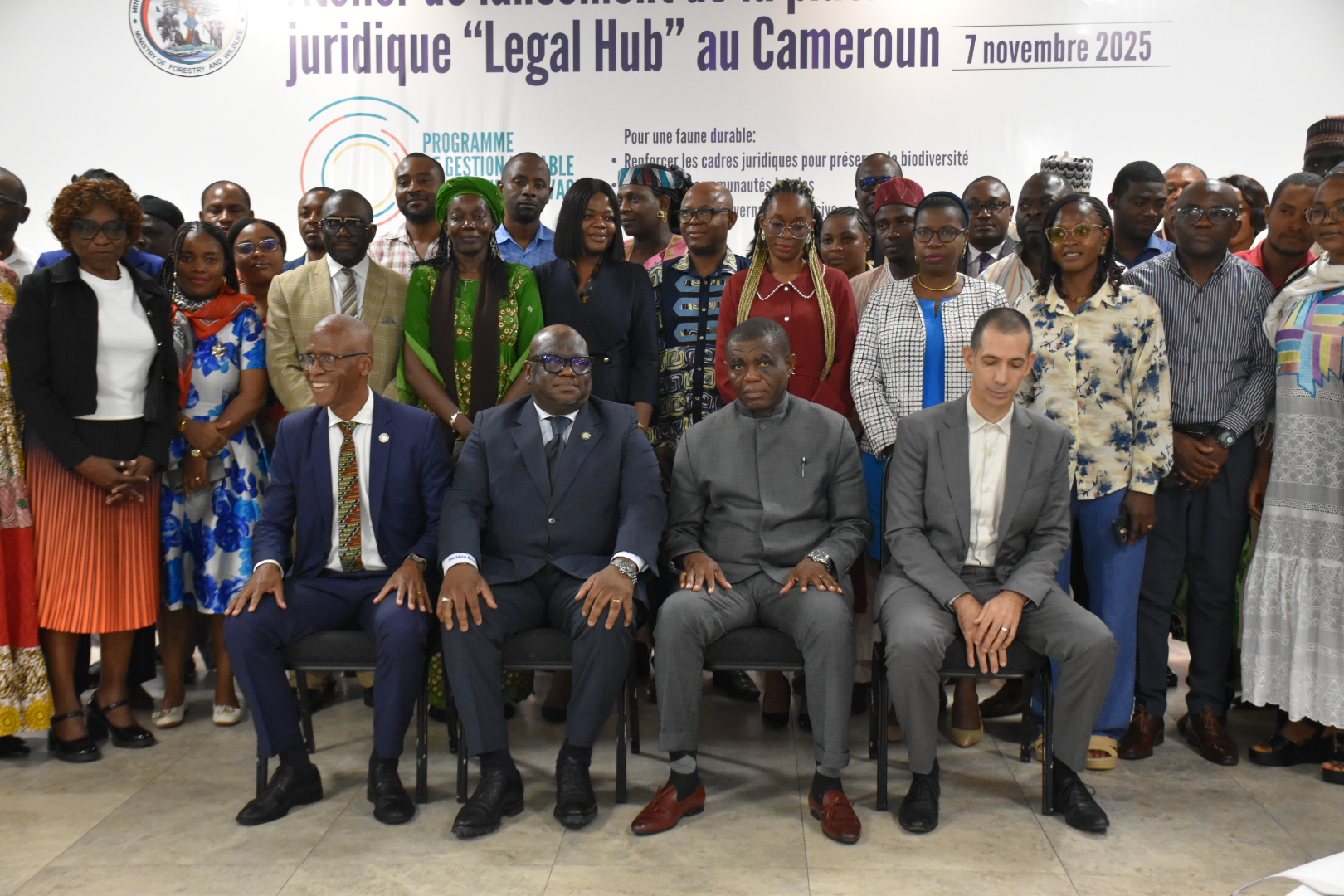
Presented during a workshop in Yaoundé, the Legal Hub is the result of a strong collaboration between the Ministry of Forestry and Wildlife (MINFOF) and the Food and Agriculture Organization of the United Nations (FAO), under the Sustainable Wildlife Management (SWM) Programme.
The platform draws on months of technical consultations and legal workshops involving government institutions, legal experts, and international partners.
A Response to Wildlife Decline and Rural Hardship
The Legal Hub was created in response to the growing pressure on Cameroon’s natural habitats — from poaching, illegal logging, and overexploitation of wildlife — which threatens both biodiversity and rural livelihoods.
By centralizing and making accessible key legal analyses, the platform aims to strengthen the country’s legal framework for sustainable and equitable biodiversity management.
It supports the implementation of Law No. 2024/008 of 24 July 2024 on Forests and Wildlife, a landmark legislation reflecting Cameroon’s commitment to protecting biodiversity, customary community rights, and combating environmental crime.
“This is a strategic tool for environmental justice, a response to sustainability and resilience challenges, and a collaborative and inclusive approach,” emphasized Dr. Antonio Luís Querido, FAO Representative in Cameroon.
A Strategic Tool for Legal Modernization
The Legal Hub is designed to centralize, structure, and disseminate legal analyses related to wildlife, offering an interactive repository of national and regional texts. It also provides a knowledge base for future reforms and capacity-building initiatives for lawmakers, conservationists, and local communities.
The launch workshop showcased the results of legal analyses conducted since 2024 and presented a roadmap for legal reform support, including the development of training modules tailored to different audiences.
“The Legal Hub is a symbol of strong political will to reinforce the rule of law in the forestry and wildlife sector, combat illegal exploitation of natural resources, and promote environmental and social justice,” said Joseph Nyongwen, Secretary General of MINFOF.
Protecting People and Nature
Sustainable wildlife management is vital to the food security, income, and cultural identity of rural and Indigenous communities. Yet, these populations face growing challenges — from poaching to land-use conflicts — that endanger both their livelihoods and the ecosystems they depend on.
In this context, the Legal Hub emerges as a governance tool to reconcile biodiversity protection with community resilience and social equity. It also contributes to several Sustainable Development Goals (SDGs), including those on sustainable ecosystems, hunger reduction, and inclusive institutions.
“Together, let’s make the law a tool for progress, social justice, and ecological sustainability,” Dr. Querido concluded.
About the SWM Programme
The Sustainable Wildlife Management (SWM) Programme is a major international initiative aimed at improving the conservation and sustainable use of wildlife across forests, savannahs, and wetlands.
Funded by the European Union and co-financed by the French Global Environment Facility and the French Development Agency, the programme operates in 16 countries across Africa, Asia, and Latin America.
It is coordinated by a consortium of four partners — FAO, CIFOR-ICRAF, CIRAD, and the Wildlife Conservation Society (WCS) — with implementation in Cameroon led by CIFOR-ICRAF.