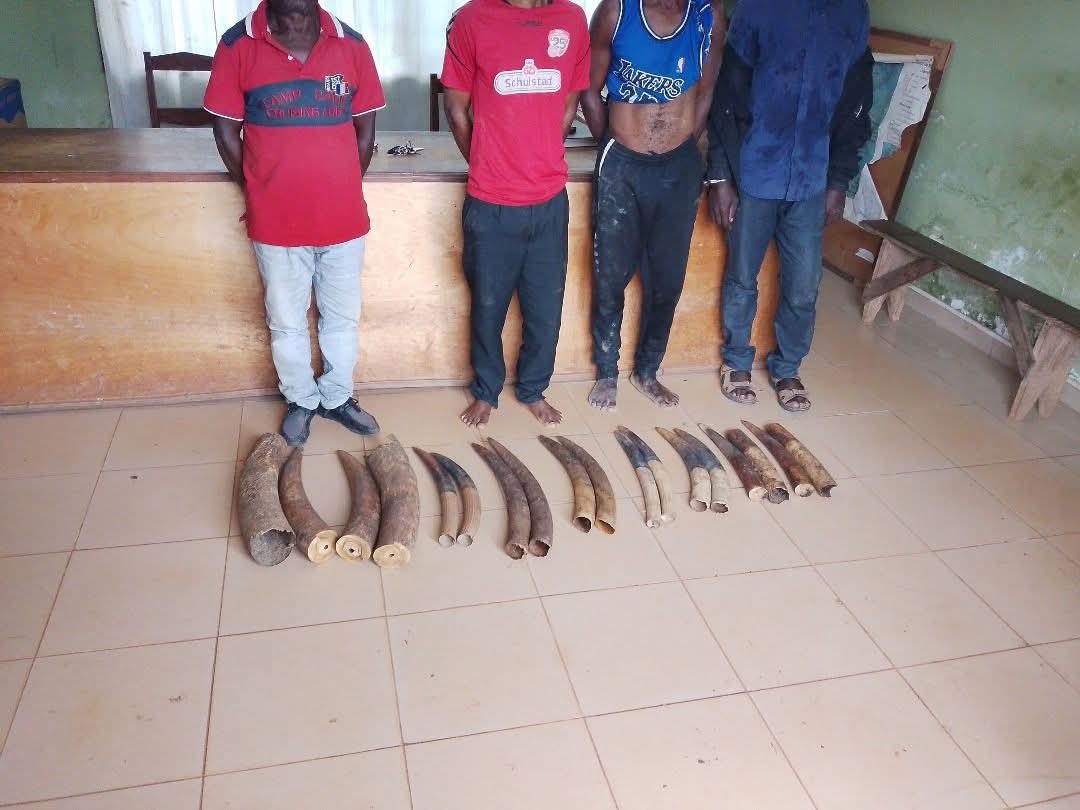
The events occurred on November 12, 2025, in Makokou, a town located in northeastern Gabon. Four Gabonese traffickers — including a repeat offender previously convicted for the same crime — were arrested during a joint operation by the Water and Forests Administration, the Judicial Police, and the NGO Conservation Justice. A total of 14 elephant tusks were seized.
The Provincial Directorate of Water and Forests of Ogooué-Ivindo and the Judicial Police, supported by Conservation Justice, apprehended the suspects in possession of the tusks. They were caught in the act as they attempted to sell the illegal wildlife products.
One of the men is a well-known repeat offender: he had already been arrested in 2019 and 2023, and sentenced to prison for similar offenses.
The suspects are currently held in police custody in Makokou and will soon be brought before the Special Prosecutor. Gabon’s legal framework is particularly strict regarding wildlife crime.
Under Article 390 of the Penal Code, offenders convicted of ivory trafficking face up to 10 years in prison and a fine equivalent to five times the value of the seized ivory.
This latest arrest highlights the continued efforts of authorities to curb a trafficking network that severely impacts elephant populations in Gabon’s forests.
A Global Issue Amid COP30
As COP30 unfolds in Belém, the fight against poaching resonates on a global scale. Elephants play a crucial role in maintaining the balance of tropical ecosystems.
According to Luc Mathot, Executive Director of Conservation Justice : “The elephant, a true gardener of the forest, promotes natural regeneration and the growth of dense, large-diameter trees. This significantly boosts carbon sequestration.”
Scientists estimate that a single elephant helps store, each year, an amount of greenhouse gases equivalent to the emissions of 40 cars — a figure that underscores the species’ importance in combating climate change.
Fanta Mabo