Through the moving story of Cintya, 26, from Lebialem Division of the South West Region, we dive into the silent and brutal world of internally displaced women, trapped between war, destitution, and the fragile hope of redemption.
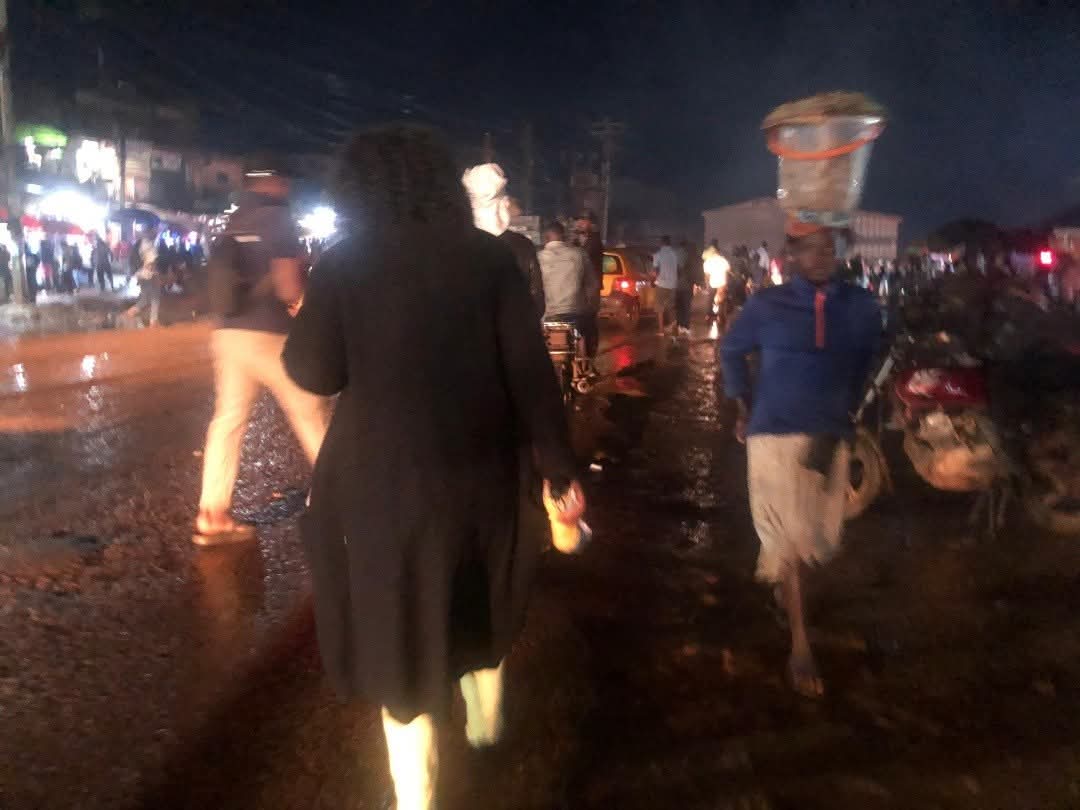
In Yaoundé VI Subdivision, at carrefour MEEC, situated nearby to the locality of Nkol- kak, near Chefferie Etetak, a few metres away from the Mokolo neighouhood, it’s past 10 p.m. The rain has stopped, leaving puddles of water on the road that reflect the few streetlights still shining. At the turn of an alley, Cintya, 26, walks slowly, her gaze fixed, shoulders hunched under an oversized coat. Around her, other young women wait for cars. Their faces are painted with courage, but their eyes reveal the fatigue of lives that never gave them a choice.
Originally from Menji, in the Lebialem Division of the South West Region, Cintya was only 19 years old when the war broke out. Her father, a mason, was killed in 2019 during an ambush between separatists and defense forces. Her mother and two younger brothers fled to Douala. She, alone, took the road to Yaoundé.
“I thought it was the start of a new life,” she whispers. “But here, everything is harder than one can imagine. People think that because we come from the war zone, we chose this life. No one chooses to sell her body”.
The capital, supposed to be a refuge, quickly became a trap. Without a diploma, family, or government assistance, Cintya moved in with an acquaintance in Mvan.
“She told me I could help her sell clothes. After a few weeks, I realised it wasn’t clothes she was selling. It was our bodies,” she recalls. “The first time, I cried all night. But later, I told myself: I have to eat. I have to survive”.
The Forgotten Victims of the Anglophone Crisis
According to data from the UN Office for the Coordination of Humanitarian Affairs (OCHA), more than 712,000 Cameroonians have been displaced within the country since the Anglophone conflict began in 2017, over 60% of them are women and adolescent girls. A UNHCR survey published in 2024 shows that nearly 70% of them live without stable employment or housing.
In Yaoundé and Douala, they are concentrated in the city’s outskirts: Mvan, Nsam, Bonabéri, Makepe-Missoké, or PK14. With no opportunities or support, many end up in what aid groups describe as survival prostitution.
Thiery Ndimi, president of the Association for Equality and Well-being (ASEBE) in Yaoundé, assists dozens of displaced young women. He sounds the alarm: “These girls are double victims, first of the war, and then of society. Many were raped or exploited on their way to safety. When they reach the city, they have no papers, no housing, and no hope. Some fall under the control of networks that exploit their despair”.
ASEBE data shows that around 45% of the displaced women it follows admit to having turned to prostitution at least once to survive. Others sell small goods on the streets or become domestic workers under near-slavery conditions.
“They live in filthy rooms, with no access to healthcare or social protection,” Ndimi continues. “Some don’t even have ID cards. Without documents, they can’t work, register for aid programmes, or even rent safely. They’re invisible”.
The Night as the Only Horizon
Today, Cintya earns an average of 3,000 to 5,000 CFA francs per client, sometimes less. She shares a small room with two other girls from the North West.
“We manage,” she says with a faint smile. “But the street is dangerous. You can meet a violent client or a policeman who wants to arrest you and take your money”.
She recounts that some nights, they return home empty-handed. Other times, they run when patrols arrive.
“We often hide in alleys or bars whose owners or bartenders know us. But the fear never leaves us,” Cintya discloses.
According to Women in Alternative Action (WAA), an NGO based in Douala, one in three sex workers in Cameroon’s major cities is an internally displaced woman from the Anglophone regions. Since 2023, the organisation has led a resilience and counseling programme for these women.
Dr. Gladys Nfor, project coordinator in Douala, explains: “Many of them suffer from depression, trauma, and untreated sexually transmitted diseases. We’ve set up mental health workshops and support groups. But our resources remain extremely limited”.
A Médecins du Monde study (2024) confirms that nearly 58% of internally displaced women interviewed in Douala and Yaoundé have suffered sexual violence, and over 40% have never had medical consultation since fleeing the conflict zones.
Survival — But at What Cost?
For these young women, the street is both refuge and prison. Some find fragments of solidarity. At night, they exchange advice, share meals, or laugh for a brief moment.
“Sometimes we lend each other money or share soap,” says Cintya. “We protect each other because no one else does”.
But beneath these gestures of survival lies constant fear; fear of violent clients, of the police, of sexually transmittable diseases, and of society’s judgment.
A Reach Out Cameroon study (2023) found that 78% of displaced women in urban areas report experiencing at least one form of stigma linked to their situation — contempt, job rejection, or accusations of immorality.
Esther Mbang, programme manager at Reach Out, explains: “These women aren’t asking for charity; they’re asking for dignity. They want to learn a trade and contribute to society. We’ve launched training programmes in tailoring, hairdressing, and community hygiene for about a hundred of them — but the needs are enormous”.
The State’s Guilty Absence
Asked about the role of the government, Thiery Ndimi is blunt: “The State can’t keep ignoring this social crisis. The Ministries of Social Affairs and Women’s Empowerment must go beyond speeches”.
“We need targeted programmes for displaced women, more trainings, financial aid, and above all, legal recognition of their status,” he asserts.
Yet official initiatives remain scarce. There are no national statistics on survival prostitution in Cameroon. Most assistance programmes are run by international NGOs, often dependent on external funding.
Our requests for comment from the Ministry of Social Affairs and the Ministry of Women’s Empowerment and Promotion of the Family went unanswered, despite multiple follow-ups.
A Glimmer of Hope: Rebuilding Dignity
In Douala, Women in Alternative Action (WAA) now works with UN Women Cameroon through the “Women on the Move” programme, designed to provide psychosocial and economic assistance to over 500 displaced women over two years. In Yaoundé, ASEBE recently secured small funding to open a community listening centre in Nsam, offering training and legal support to victims.
“We need more support, but also a change in mentality,” insists Thiery Ndimi. “As long as we judge these girls instead of understanding what they’ve endured, nothing will change”.
For Cintya, the future remains uncertain. But she still holds onto hope: “I want to leave the streets. I want to become a hairdresser. If someone gives me a chance, I’ll take it, beecause I don’t want to live like this anymore”.
Her words resonate as a plea, fragile, yet powerful, for collective responsibility.
Internally Displaced Women in Cameroon: Key Figures (OCHA, UNHCR, Reach Out, 2024)
| Indicator | Estimated value |
| Internally displaced persons since 2017 | 712,000 |
| Women and adolescent girls among them | 62% |
| Displaced persons living in Yaoundé and Douala | 47% |
| Rate of survival prostitution (displaced women) | 45% |
| Reported victims of sexual violence | 58% |
| Access to income-generating activity | 25% |
| Displaced women receiving psychosocial support | < 20% |
These figures expose a reality many prefer to ignore: the war has not only destroyed villages; it has shattered lives. Lives of young women forced to survive in the shadows of an indifferent government.
For them, peace is not merely the end of gunfire; it will come the day their bodies are no longer battlefields, but spaces of freedom.
Fanta Mabo
This article was produced as a result of a grant provided by the Cameroon Association of English-speaking Journalists (CAMASEJ) as part of a project funded by Open Society Foundations.