 Story, Louvier Kindo Tombe
“It is no longer time to talk. It is time to act and save our society.”
With this uncompromising mandate, Dr. Ngala Desmond, the Chief Executive Officer of Civic Watch Cameroon, set the tone for a high-stakes national mobilization as the country marked the 2026 International Day to Counter Hate Speech. The event was provoked by the fact that words, in the wrong hands, have become flammable across Cameroon.
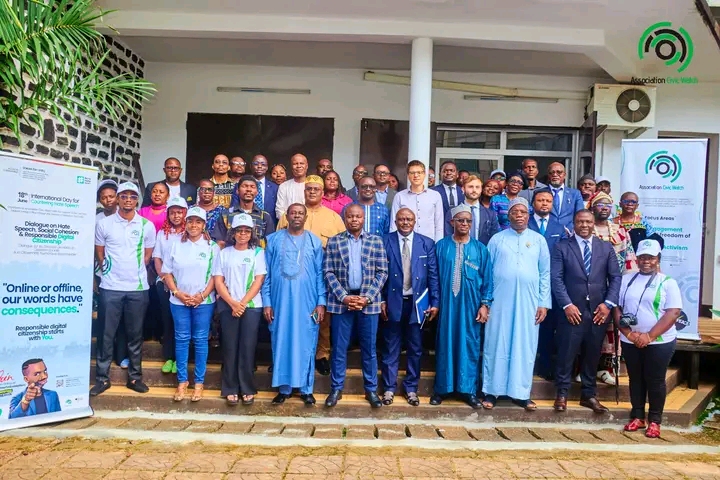
To confront the very actors pulling these strings, Civic Watch Cameroon convened a pivotal Multi-Stakeholder Dialogue Forum. Bringing together lawmakers, media executives, traditional authorities, and civil society, the national session pulled back the curtain on a disturbing reality: hate speech is an engineered political tool, and the time for passive dialogue has officially run out.
The Elite Puppet Masters
For too long, public discourse on hate speech has focused on anonymous online trolls. However, during the forum, lawmakers pointed their fingers upward, directly at the country’s influential figures.
Hon. Njume Peter Ambang, Member of Parliament representing the Ekondo Titi and Dikome Balue constituency in the Ndian Division of Cameroon’s South West Region delivered a blistering critique of the societal role models who weaponize their positions for political mileage, shifting the blame from an impressionable public to the powerful few who orchestrate the noise.
“We have to hold elites responsible for fanning hate speech; some of them hold media platforms that convey hate,” Hon. Njume challenged the room.
“People believe in elites, but elites are not actually committed to countering hate. Elites need to confront hate by practicing responsible online and offline citizenship.”
The danger of this rhetoric is that it thrives on a false premise: that division equals political strength. Yet, on the floor of the dialogue, the fallacy of using hate as a strategy was challenged.
Hon. Koupit Adamou from the West Region cut straight to the core of this manipulative calculus with a sharp, uncompromising reality check for anyone seeking to ride a wave of prejudice into power.
“You don’t win elections through hate speech,” Hon. Koupit declared.
His words served as a sobering reminder that true societal mandates are built on substance, policy, and public trust, not on the fleeting, destructive highs of tribal or regional polarization.
Bridging Law and Grassroots Action
If the elites are the architects of division, then parliamentarians and local leaders must become the frontline defenders of unity. Hon. Agho Oliver, representing the Tubah/Bafut constituency, reminded the forum that while Cameroon has passed laws to criminalize hate speech and tribalism, a law on a piece of paper is powerless without a collective backbone to enforce it.
“Partnership is vital in countering hate speech. There are no better persons to fight hate speech than parliamentarians,” Hon. Agho argued, emphasizing the unique duty of elected officials.
“MPs are the voices of the local people. Laws have been passed, the issue now is for us all to play our part.”
Guarded by Tradition, Refined by the Press
 This legislative push found powerful reinforcement as traditional leaders and media gurus joined their voices to shun hate, creating a formidable alliance between ancestral authority and modern information networks.
Traditional rulers, custodians of the community’s conscience, spoke out against the desecration of cultural values for political mileage. They emphasized that true leadership protects the vulnerable and fosters hospitality, completely rejecting the weaponization of geographic slurs that alienate fellow citizens.
By pledging to use their traditional palaces and local assemblies as sanctuaries for tolerance, they vowed to neutralize divisive rhetoric before it takes root at the grassroots level.
Simultaneously, media executives and editorial gurus took the floor to confront the rot within their own industry. Acknowledging that some platforms have been compromised by political interests, these press leaders committed to strict editorial gatekeeping.
They pledged to starve hate-mongers of airtime, refuse the broadcast of sensationalized ethnic profiling, and actively deploy fact-checking tools to disarm viral lies.
The Ultimate Test: Upcoming Elections
This national awakening comes at a moment when Cameroon can least afford complacency. Down the line, the shadow of the highly anticipated October presidential elections looms large.
Elections are the ultimate test of a nation’s maturity. If left unchecked, the inflammatory rhetoric generated today will inevitably collide with the high stakes of the ballot box tomorrow.
The forum made it clear that fixing the media environment during an election campaign is already too late; the work of defusing the bomb must happen now.
Dr. Ngala Desmond’s opening warning echoed through the closing declarations: this is an operational blueprint, not a statement of intent. By demanding elite accountability, mobilizing traditional institutions, and challenging the press to reclaim its ethical compass ahead of the upcoming elections, Cameroon’s stakeholders are drawing a hard line.
The message to the architects of division is final: the country’s peace will no longer be sacrificed for a few cheap votes, and worse through hate.