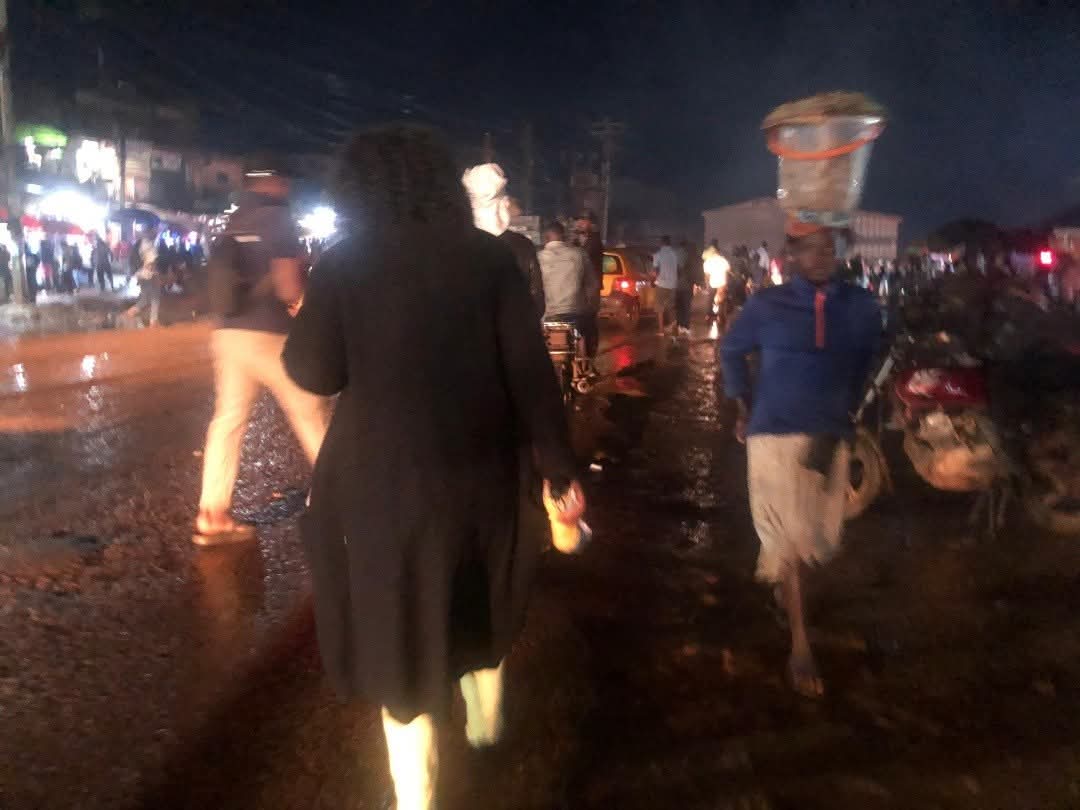
In Yaoundé, Carrefour Mec, not far from Mokolo. It’s past 10 p.m. The rain has stopped, leaving puddles that reflect the dim streetlights. In a narrow alley, Cintya, 26, walks slowly, her gaze fixed ahead, shoulders buried in a coat too big for her. Beside her, other young women scan the road for cars. Their faces wear the mask of courage, but their eyes betray exhaustion, the fatigue of a life that has never given them a choice. By chance, and with a small bribe, we could manage to convince Cintya to share her story.
Originally from Menji, in the Lebialem Division of the South-West Region, Cintya was only 19 when the war began. Her father, a bricklayer, was killed in an ambush in 2019. Her mother and two younger brothers fled to Douala, while she made her way to Yaoundé.
« I thought it was a new beginning, » she murmurs. But the capital, which she imagined as a refuge, quickly became a trap.
Without a diploma, without family, and without government aid, Cintya first stayed with a woman she knew in Mvan. « She told me I could help her sell clothes. After a few weeks, I realized we weren’t selling clothes, we were selling ourselves. »
She lowers her eyes. « The first time, I cried all night. But then I told myself, you have to eat. You need to survive. ».
Forgotten Victims of the Anglophone Crisis
Like her, hundreds of internally displaced young girls and women have fallen into what local NGOs describe as survival prostitution. According to the UN Office for the Coordination of Humanitarian Affairs (OCHA), more than 712,000 Cameroonians have been displaced within the country since the start of the Anglophone conflict. A significant number are women and teenage girls are left to fend for themselves in Yaoundé and Douala.
Local associations such as Reach Out Cameroon and Women in Alternative Action (WAA) are raising the alarm. « These girls are twice victims—of war and of society, » says Thiery Ndimi, president of the Association for Equality and Well-being (ASEBE) in Yaoundé. Many were raped while fleeing; others are now trapped in networks that exploit their desperation.
They live in cramped, unhygienic rooms, with no access to healthcare or social protection. « Some don’t even have ID cards,” Ndimi adds. “They can’t work legally or access aid programs. »
When the Night Becomes the Only Option
Today, Cintya earns between 3,000 and 5,000 CFA francs per client, sometimes less. She shares a tiny room with two other girls from the North-West. « We manage, » she says with a sad smile. She dreams of going back to school and becoming a hairdresser. But escaping this life is almost impossible without help.
At night, on the sidewalks, these young women pass each other without speaking much. Some are barely 17. They share brief looks, small gestures of solidarity, but fear is constant : fear of violent clients, police raids, sexually transmitted diseases, and society’s judgment.
Across Cameroon, a few organizations are trying to break this vicious cycle. Women in Alternative Action (WAA) work with psychologists to help these girls rebuild thier self-esteem. Reach Out Cameroon offers training in tailoring and hairdressing for displaced women. But these efforts remain limited and poorly coordinated with government programs. Ministries in charge of social affairs and women’s empowerment are yet to provide any structured response. Requests for comment from both ministries remain unanswered.
By Fanta Mabo