Story, Louvier Kindo Tombe
Clean cooking remains a major development challenge in Cameroon, where more than 70 percent of households still rely on firewood and charcoal. This heavy dependence continues to expose families, especially women and children, to indoor air pollution, while accelerating deforestation and greenhouse gas emissions.
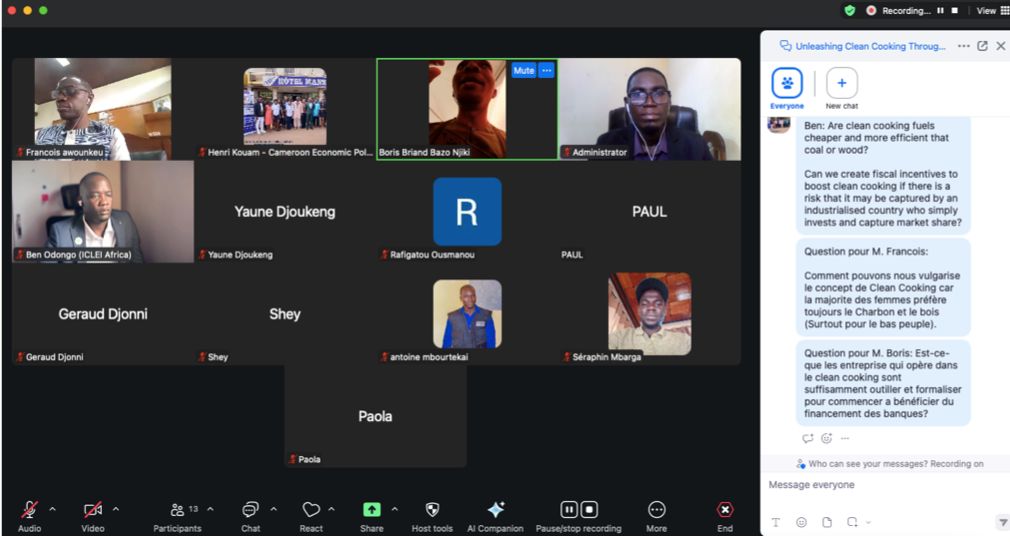
These concerns were at the center of a virtual policy dialogue held on 14 November 2025, organized by the Cameroon Economic Policy Institute (CEPI) and the Henri Kouam Foundation under the theme “Unlocking the Potential of Clean Cooking through Economic Freedom in Cameroon.”
Moderating the discussion, CEPI National Coordinator Haiwang Djamo stressed that clean cooking must be integrated into national strategies on energy transition and economic growth, rather than treated as a purely social issue.
Awareness and Affordability Gaps
Panelists agreed that low adoption of clean cooking solutions is driven by limited awareness, high costs, and weak distribution networks. Mr. Boris, a clean cooking innovator, noted that technology alone is not enough.
“Without awareness, even the best improved cookstoves will not be adopted,” he said.
Although women often recognize the benefits of clean cooking, panelists observed that information gaps and affordability constraints continue to slow uptake.
Structural and Policy Constraints
Mr. Awounkeu linked the slow transition to deeper economic and institutional weaknesses, including inadequate training in clean energy fields and poor policy prioritization.
“Our economic model does not encourage innovation in clean energy,” he argued, warning that Cameroon is losing out on jobs and local innovation.
He called for stronger advocacy, better integration of clean cooking into SME support mechanisms, and improved public awareness of existing international support.
Financing and Economic Opportunities
From a financing perspective, Mr. Ben pointed to high costs as the main obstacle.
“Clean cooking solutions remain too expensive for most households,” he said, citing electricity-based cooking as a clear example.
Despite these barriers, panelists highlighted the sector’s strong job-creation potential across manufacturing, fuel production, distribution, and maintenance.
Small-scale innovations, including recycling-based stove production, were cited as examples of inclusive economic activity.
The Case for Economic Freedom
Speakers concluded that lowering taxes, reducing regulatory barriers, and encouraging competition could significantly improve affordability and adoption.
According to the panel, market-driven reforms would not only expand access to clean cooking technologies but also stimulate local production, entrepreneurship, and employment.
CEPI reiterated its commitment to advancing clean cooking through evidence-based research and policy advocacy, positioning the sector as a key driver of sustainable development and economic freedom in Cameroon.