Story, Louvier Kindo Tombe
At dawn in northern Cameroon, 11-year-old Aisha often leaves for school without breakfast. Some days, she does not go at all. Hunger dulls her concentration, and the nearest health center is several kilometers away. When she falls sick, her mother weighs the cost of treatment against the family’s next meal.
“I want to be in class like the others,” Aisha says quietly. “But when you are hungry, your head cannot listen.”
Aisha’s story is not unique. Across Cameroon, thousands of children face malnutrition, limited access to healthcare, unsafe learning environments, and protection risks, not because solutions do not exist, but because their needs are often invisible when public budgets are drawn.
It was children like Aisha that Samuel, a junior parliamentarian, had in mind as he stood inside Cameroon’s National Assembly, his small voice echoing in a space usually reserved for adults.
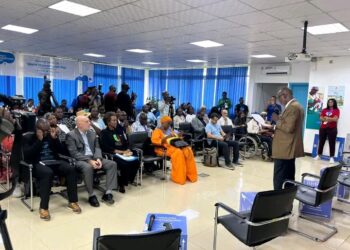
Samuel was among 180 junior parliamentarians from Cameroon’s ten regions gathered in Yaoundé under a UNICEF-led initiative promoting child-sensitive budgeting, an approach that places children’s real needs at the center of planning and public spending.
“Adults decide budgets, but they don’t always feel what children feel,” Samuel told the assembly. “When there is no food in school or no medicine in hospitals, it is children who suffer first.”
His words cut through policy language, grounding national discussions in lived experience.
According to Agnès Yolande Abena, Child Protection Specialist at UNICEF-Cameroon, child-sensitive budgeting is about more than numbers.
“It means planning with children and all stakeholders so that children’s rights are not just written in laws, but reflected in actions that touch their daily lives, health, nutrition, education, and protection.”
Why UNICEF says the system must change
Despite ongoing investments, UNICEF warns that gaps in planning and prioritization continue to expose children to preventable harm.
“When we look at the indicators,” says Anne Fouchard, Head of Partnership, Advocacy and Communication at UNICEF-Cameroon, “we still see children suffering from malnutrition, babies dying in their first months because they cannot access healthcare, and families left without support.”
These are not abstract failures. They are realities children like Aisha live with every day.
UNICEF’s intervention, launched as part of Children’s Month in Cameroon on June 3, 2025, seeks to change how decisions are made, by ensuring children are not passive recipients, but active participants in shaping policies that affect them.
Listening to children changes the picture
Inside the forum, junior parliamentarians examined government actions taken in their favour, questioned gaps, and proposed priorities rooted in their communities.
“As adults, we do not have the same needs as children,” Anne Fouchard acknowledges. “That is why listening to children is essential. They see problems differently, and often earlier.”
For Samuel, the message was clear: budgeting must reflect childhood realities, not assumptions.
“When you budget without asking children, you forget children like Aisha,” he said.
The money, and what it must achieve
In 2025, Cameroon allocated 2.88 billion FCFA to its social protection programme for children. UNICEF insists that funding alone is not enough.
What matters, experts say, is how budgets are planned, monitored, and adjusted, and whether they respond to real needs on the ground.
The upcoming 26th session of the Children’s Parliament, themed “Mobilization of the national community for child-rights-sensitive planning and budgeting,” is expected to further strengthen this dialogue between children and decision-makers.
From Aisha to the Assembly — and back
As discussions ended in Yaoundé, Aisha remained in her village, unaware that her story had been carried into the halls of power by children like Samuel.
But that is precisely the goal, UNICEF says, to ensure that no child’s reality is absent from national decisions.
“Child-sensitive budgeting,” Agnès Abena notes, “is about dignity. It is about ensuring that every child, regardless of where they are born, has a fair chance to survive, learn, and thrive.”
For Aisha, that could mean a school meal, a nearby clinic, or simply the strength to stay in class until the end of the day.
And for Samuel, standing inside the National Assembly, it means making sure children like her are no longer invisible when Cameroon plans its future.