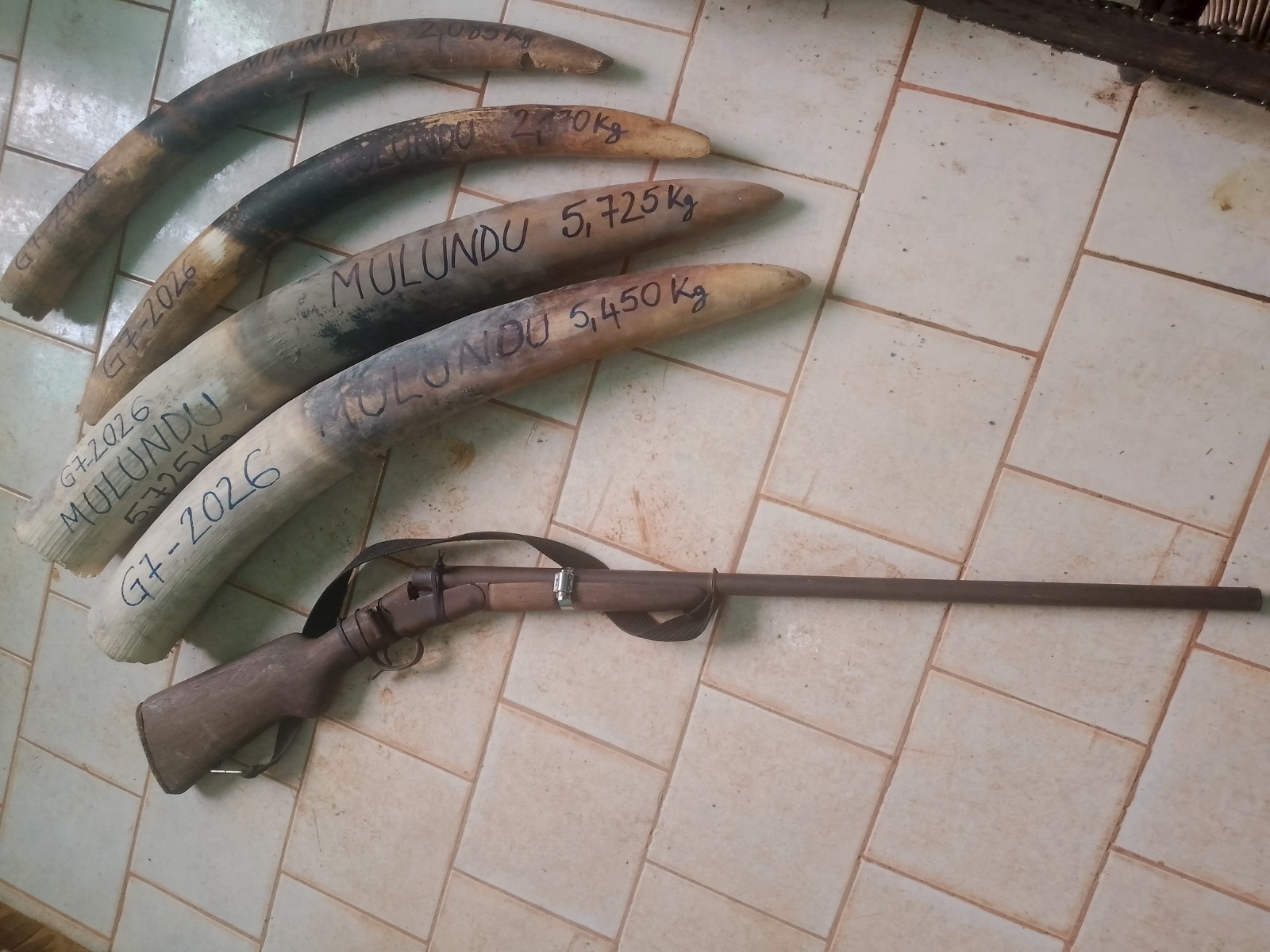
Known as the gardeners of tropical forests, forest elephants (Loxodonta cyclotis) continue to fall victim to poaching in Gabon, where ivory trafficking cases are regularly uncovered through field investigations conducted by judicial authorities. In Lipaka 2, a village along the Lastoursville–Moanda road in the Mulundu Department, four individuals have just been arrested for the illegal possession of four elephant tusks.
Although ivory trafficking declined in Gabon around 2010, it experienced a resurgence in 2018–2019. Driven by this illegal activity, which is punishable under the Criminal Code, poachers and traffickers organise the killing of elephants to obtain their tusks for illegal trade. The arrest of traffickers in the village of Lipaka 2 is yet another illustration of this reality.
After receiving information from a concerned citizen that an elephant had been killed in the village, Water and Forestry officers travelled to the scene to investigate the circumstances surrounding the killing. They discovered the elephant’s carcass, but its tusks were missing.
Investigations conducted by law enforcement officers and Water and Forestry officials led to the arrest of five individuals on 22, 23 and 24 September 2026. Two additional elephant tusks were discovered, alongside those belonging to the elephant that had been killed. A 12-gauge firearm and homemade ammunition, found in the possession of one of the suspects, were also seized. In total, four elephant tusks, corresponding to two elephants killed, were recovered during the investigation. One suspect was released after investigators established that he was not involved in the offences.
The suspects appeared before the Public Prosecutor’s Office in Libreville on 28 September 2026, and a judicial investigation was opened. The investigating judge issued two detention warrants and granted provisional release to two of the four suspected ivory traffickers. The case is now proceeding through specialised judicial proceedings. Under Article 390 of Gabon’s Criminal Code, the alleged offenders face up to ten years in prison and a fine equivalent to five times the value of the seized items.
According to estimates, approximately 95,000 forest elephants still inhabit Gabon, accounting for more than half of the remaining population of this iconic species, whose numbers have declined dramatically in neighbouring countries. Thanks to its extraordinary biodiversity, Gabon attracts visitors, investors and philanthropists who support government agencies and their partners in conservation efforts.
As this case illustrates, Gabon’s forest elephant population nevertheless remains under several pressures, including poaching, habitat loss and climate change. Reduced fruit production in forests disrupts the elephants’ food supply and increases crop-raiding incidents on agricultural plantations.
Raising awareness, developing alternative livelihood opportunities for local communities, promoting ecotourism and enforcing the law against violations of wildlife regulations are all essential measures in the fight against ivory trafficking in Gabon.
Fanta MABO